

Examples of internal calibrations
Accelerometers (shaker tests)
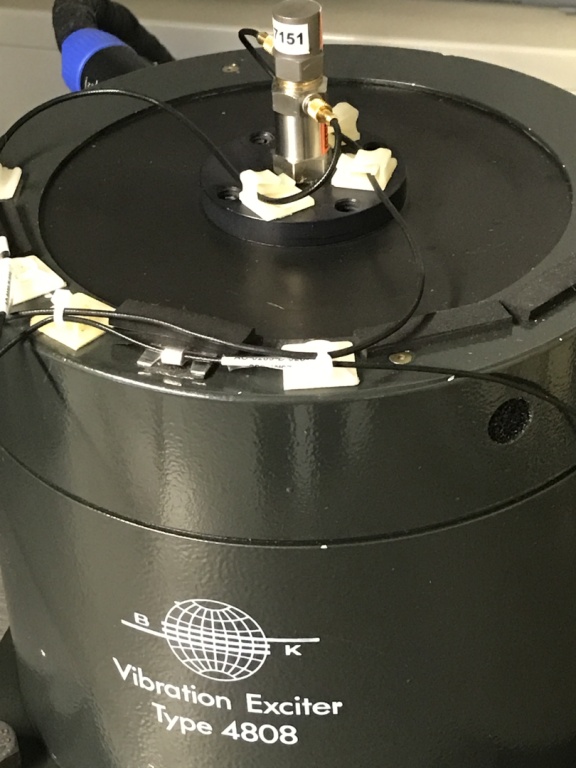
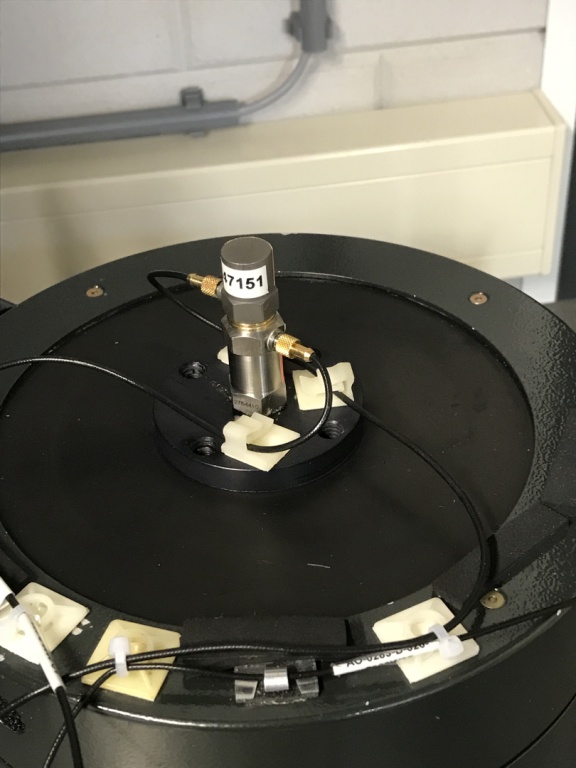
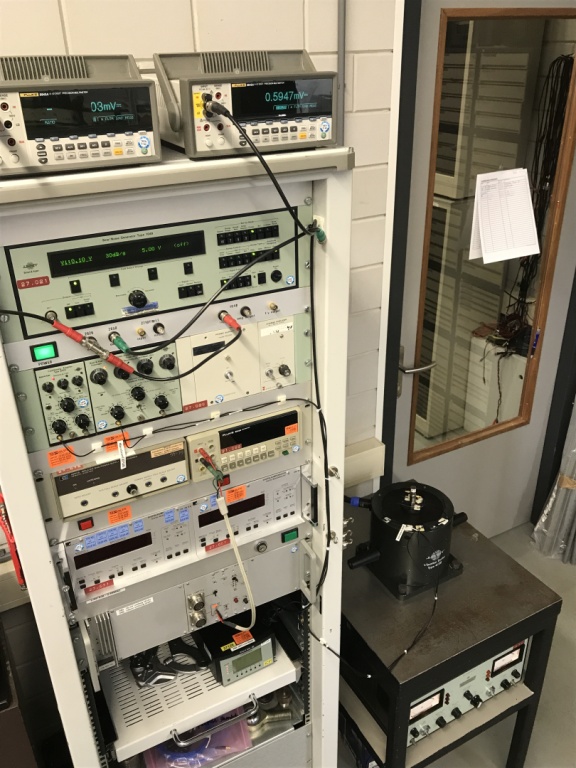
Accelerometers are essential for vibration measurements in both development and durability testing. Before they are used on a shaker setup, each device is mounted on a reference fixture and exposed to controlled vibration levels. This allows the calibration lab to compare the sensor’s output with a known reference acceleration. Any deviation is measured, and new calibration parameters are established.
This process ensures that acceleration data collected during high‑frequency vibration testing remains accurate, especially during long endurance runs where even a slight measurement error could lead to incorrect conclusions about product performance.
Load cells (strength and durability lab)
Load cells are calibrated on a dedicated force calibration bench developed in‑house. The bench applies controlled loads using a precision reference system. During calibration, the load cell is tested across multiple force levels, both increasing and decreasing, to detect non-linearity or hysteresis effects.
This detailed approach ensures that load cells provide accurate force readings for static and dynamic tests, such as fatigue testing of structural components, strength validation of assemblies, or verification of mechanical safety margins during prototype development.


Thermocouples and temperature devices
Thermocouples and other temperature measurement instruments are calibrated using controlled temperature sources. This allows their response to be verified. The verification is performed at several points across the intended measurement range.
Any deviation is corrected to ensure it reports reliable temperatures in both steady‑state and rapidly changing environments.
These calibrations are especially important for thermal cycling tests, environmental chamber tests, and component validation under heat‑related stress.
Handheld and bench multimeters
Electrical measurement devices, such as handheld and bench multimeters, are calibrated using precise voltage, current, and resistance standards. The calibration lab verifies each measurement range and function, ensuring that readings for low‑level signals as well as high‑voltage measurements remain within tolerance.
Accurate multimeters are essential for diagnostics, component characterization, wiring verification, and validation of power electronics systems.


Pressure instruments
Pressure sensors and transducers are calibrated using a hydraulic pressure balance or a gas pressure calibrator, depending on the type and range of the instrument. The calibration process includes multiple pressure points to verify linearity, repeatability, and stability over time.
This allows complete measurement chains—from pressure sensor to amplifier and data acquisition—to deliver trustworthy readings in cooling systems, hydraulic circuits, pneumatic setups, or fluid‑based durability tests.
Measurement amplifiers
Carrier-frequency amplifiers and other signal amplifiers are calibrated to ensure that the full measurement chain remains stable. The calibration lab checks gain factors, offset levels, noise behavior, and frequency response.
Accurate amplifier settings are critical, especially when working with strain gauges, load cells, accelerometers, or sensors that produce small signals. Even minor amplifier errors can lead to significant deviations in the final test results.
